Give with one hand, take away with the other
ALCOHOL RULES MAY EASE AS 'VISA RUN' RULES GET TOUGHER

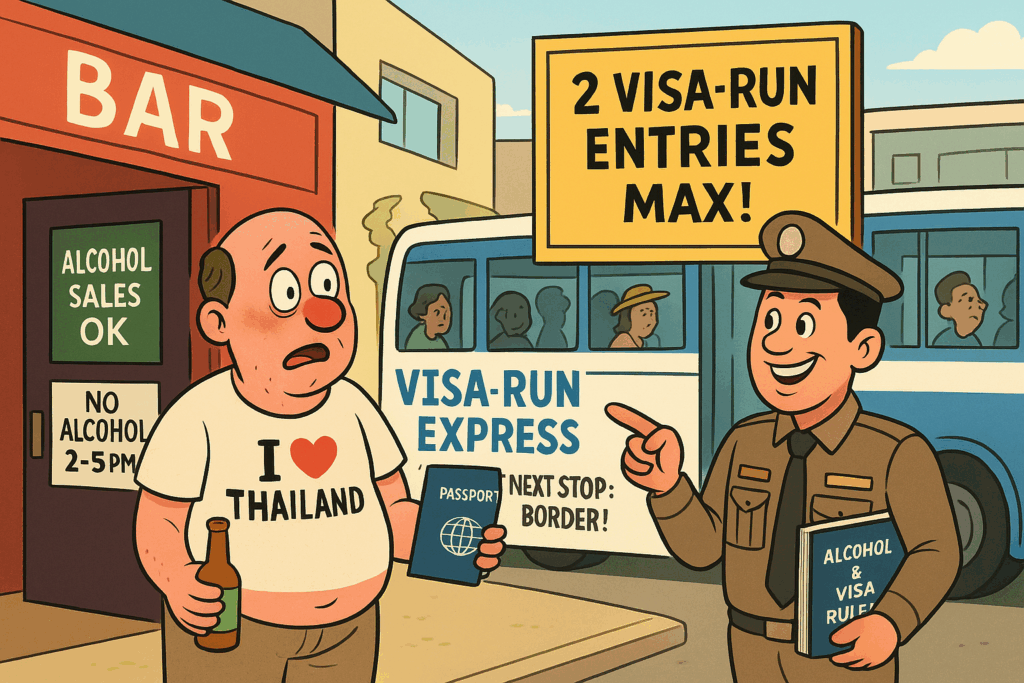
The Thai government’s version of ‘doing the Hokey Cokey’ is ongoing in the past week, as they put their left foot in (it) with announcements of both stricter fines and enforcement of alcohol and visa exemption rules, while then putting their right foot out by easing the former and clarifying the latter, leaving both tourists and expats shaking their heads all about. It is not unusual in Thailand for politicians to make public announcements that are somewhat devoid of detail but are more like running an idea up a flagpole to see who salutes it, in other words gauging business and public reaction before finalising a policy, and it seems that this approach is actually being employed more and more by politicians in western countries as well, which could be seen as a sensible approach, although does rather hint at lacking clarity of thought and decisiveness.
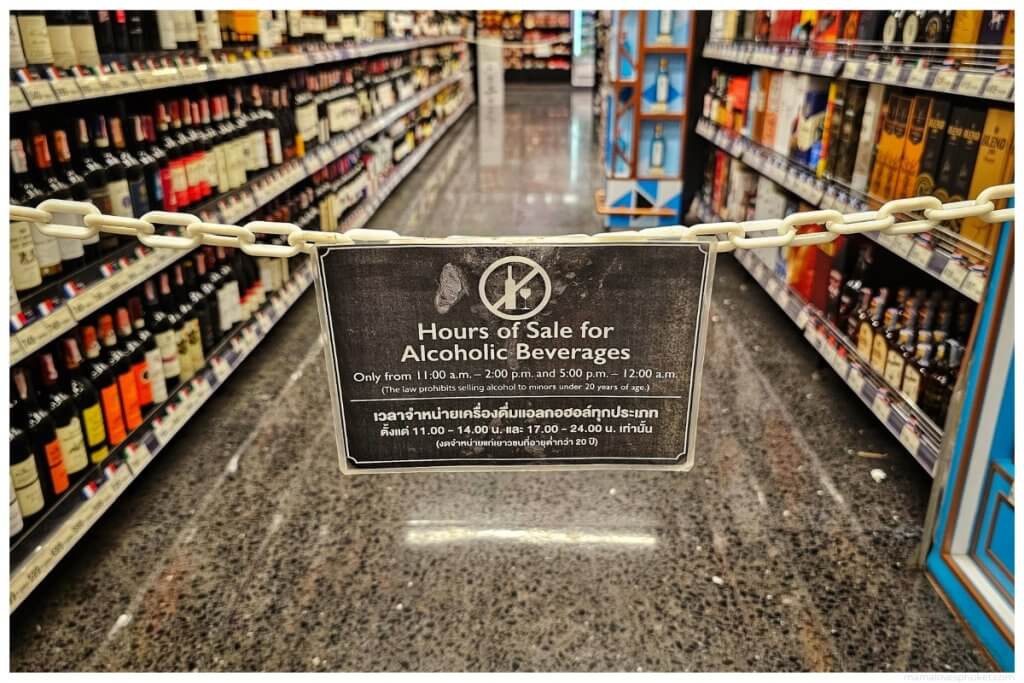
However the current public confusion is specifically regarding the afternoon hours, officially between 2 and 5pm, which were, according to the current Deputy Prime Minister Sophon Zarum, “introduced long ago to prevent civil servants from drinking during office hours. But that era is over — government officials no longer drink in the afternoon. Today, officials do not go out drinking during working hours, so the ban should be lifted”. Mr Sophon made this statement after The National Alcohol Policy Committee agreed to scrap the long-standing ban on the sale of alcoholic beverages between 2pm and 5pm, with this expected to take effect 15 days after public consultation, without requiring cabinet approval.
However, prior to this, the amended Alcoholic Beverage Control Act, which took effect on Nov 8, stipulated fines of 10,000 baht or more for drinking or being served alcoholic beverages during prohibited times or in prohibited places. That rule did not specify the times but referenced a government announcement from 23rd June, which reiterated that the sale of alcohol was permitted between 11am and 2pm and between 5pm and midnight, with exceptions for international airports, licensed entertainment venues and hotels. And the amendment also mentioned that not only the business selling the alcohol, but also the customer who consumed it in the prohibited hours would be fined, even if the drink was purchased during the allowed hours. Before this amendment there were high hopes and reports that the hours were going to be relaxed to help tourism and tourist related businesses, so it was quite a shock not only when this did not transpire but actually strengthened the existing punishments.
There are good reasons on both sides of this debate as to the merits of either keeping or relaxing the rules; on the ‘keep’ side, it is a well known fact that Thailand has one of the worst records when it comes to deaths and injuries from road accidents, and logically having more relaxed drinking hours is almost certain to make this worse; however, the counter argument to this is that this was the prediction made in the UK when they relaxed their drinking hours in 2005, and in the years since, the number of drink related accidents has been steadily falling, and while this is also partly because of a general trend towards less alcohol consumption there, it also reduced the “closing time” rush when all the pubs closed at exactly the same time, as well as the binge drinking that was common when the time allowed was restricted, and it is likely that these trends would be seen in Thailand as well. And certainly a huge reason for relaxing the rules in Thailand would be a financial one, with regard to tourism; there is now strong competition from places like Vietnam for tourists to go and spend their money, and anecdotally it seems that the rules in Thailand have been persuading people to go elsewhere, something that the tourist industry here can ill afford.
As it stands now, anyone entering Thailand on either a visa exempt stamp or a tourist visa gets permission to stay for 60 days, which can be extended for a further 30 days within Thailand, after which they must leave the country – the clarification is that they can only extend twice within a calendar year, and the second extension will only be for 7 days, not the previous 30 days. In other words, the maximum length of stay on either visa exempt or tourist visa in any calendar year is now 97 days (67 days for nationalities that can only get 30 days on their initial entry). And a further tightening of the rules is concerning the so-called visa run or border bounce – same-day departures and re-entries are now prohibited, meaning tourists can no longer leave and return on the same day to refresh their visa. Additionally, individuals who attempt visa runs more than twice risk being denied entry into Thailand altogether.
While it has not been explicitly stated, it is believed that the visa run restriction is only with land border crossings, but given that very few people, if any, fly out and back on the same day, it was probably not felt necessary to address this, and according to reports, anyone with confirmed return or onward flights will continue to receive entry regardless of the tightened rules. The details of these measures and why they are deemed necessary were announced by Police Lieutenant General Panumas, chief of the Immigration Bureau, at a meeting on Wednesday, November 12, 2025.
They established four key actions to enforce the new policy:
- Screening of individuals frequently using visa-exempt entries for border runs will be elevated. Anyone exceeding two entries without justification may face denial of entry. Authorities said this targets misuse of tourist visas for non-tourist activities.
- Authorities will intercept foreign nationals with watch-list records at border areas. Mae Sot in Tak Province is a primary checkpoint due to its proximity to scam hubs. Moreover, deported individuals from the Mae Sot–Myawaddy border are banned from reentry without exception.
- Provincial immigration offices will strictly grant temporary stay extensions. Foreigners with documented visa run behaviour may have extensions denied. Authorities may also revoke existing visas and deport individuals who abuse the system.
- All Immigration Bureau divisions will launch a mass sweep of overstaying foreigners. Authorities intend to achieve measurable operational results.
It was stressed at the meeting that these measures target tourists working illegally and who abuse regulations. Genuine visitors with short-term travel plans are expected to continue without disruption. They added that since the 60 day plus extension system had been operating, a small number of individuals have exploited the system by conducting repeated border runs and extending stays illegally, and the focus of the new measures is to close the loopholes they were exploiting.