
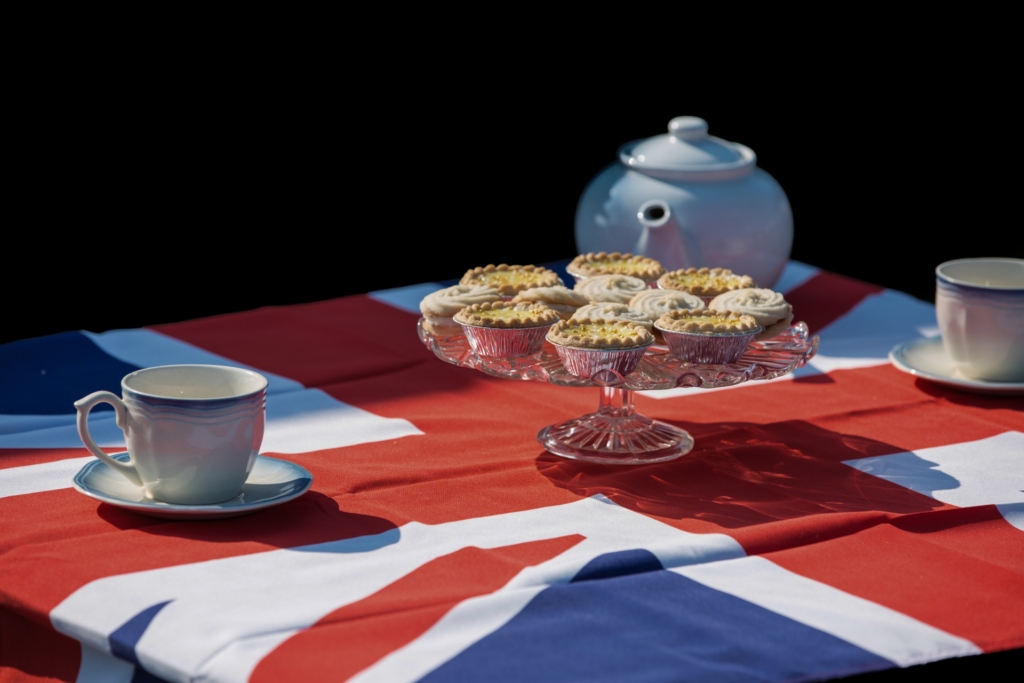
High Tea

Dinner is, for most English speakers, the main meal of the day. When the word was first used (in the 12th century) it referred to a midday meal, but it did not remain so for long. By the early 16th century it had become the first meal of the day, what we would call breakfast. No doubt those 16th century diners had their own reasons for this but it makes perfect sense etymologically as the verb to dine comes from the Late Latin disjejunare, “to breakfast” via the Old French disner. The Latin word disjejunare, incidentally, is quite literally “break fast”, being dis (“undo”) + jejunare (“to fast”) and also gave the French word déjeuner “breakfast”*. Obviously, dinner could not get any earlier than breakfast and after the 16th century it drifted through the day, being served later and later until, during the Victorian era, high society sat down to dinner at 10 p.m. Having one’s main meal of the day at such a late hour meant that many tummies were growling by late afternoon. To avoid that unpleasant hollow feeling, a new meal was invented. It was just a light snack, basically a few cakes and pastries served with the expensive new status symbol, tea. Consequently, the meal was called “tea”.

The name used for this drink tells a lot about how the word entered a language. Like French, Spanish, Italian, Dutch, German, Danish and Swedish (thé, te, tè, thee, thee, te and te, respectively) we acquired the name from Malay traders who called it te, a word they learned from the Amoy dialect of Chinese. The Portuguese, who call it cha, traded with Chinese who spoke the Mandarin dialect, in which it is called ch’a. Throughout the Middle East and India, the word is usually chai or some variant thereof. This is also the Russian word as tea reached Russia overland, via the Silk Road. In India, tea is brewed with milk and a mixture of spices called chai masala (Hindi for “tea spice”). This concoction is known as masala chai (Hindi, “spiced tea”) or simply as chai. As a result, the word chai has now entered the English language and it is not uncommon to see coffee bars offering something called chai tea (literally “tea tea”).

Many U.S. tea-shops offer something called high tea – usually a fancy affair with varietal teas, crustless cucumber sandwiches and dainty pastries, and a high price. It is our experience that these tea-shops invariably think they are providing an opportunity to sample an English tradition. They are not. This is not to say that the English don’t treat themselves to fine teas, crumpets and scones – far from it. But when they do they don’t call it high tea. In England high tea is a distinctly working-class expression which is used in the North of England to mean “dinner” and is synonymous with meat tea – tea with which meat is served. High tea is the main, cooked meal of the day, served in the early evening. Thus, fish and chips would qualify as high tea whether or not a pot of tea appears on the table.  We would like to introduce Americans to the term cream tea, which is what the British call tea served with crumpets, muffins, scones, jam and clotted cream, though the earliest recorded instance of this term comes from only 1964, at least so far!
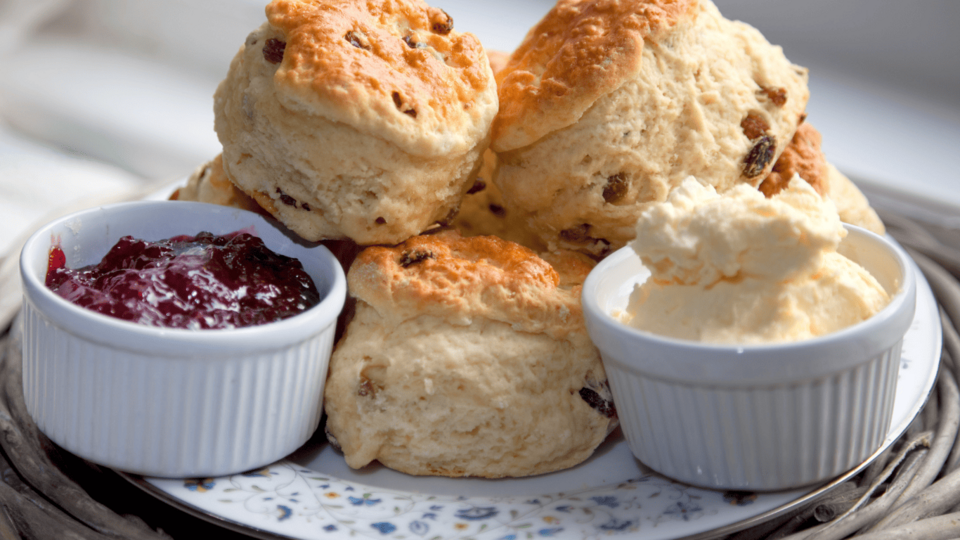
Above: A Cornish cream tea (Attribution: Soulv, CC BY-SA 4.0, via Wikimedia Commons)

But what about all those crumpets, muffins and scones? A crumpet is a round, flat bread with many holes on its upper surface. The word crumpet first appears in the 14th century in the expression a crompid cakeCrompid here means “curled up” (just like cruller, by the way) which suggests that the original crompids were somewhat different from our crumpets. In the Midlands and West of England you might hear crumpets called pikelets. This is one of the very few instances of the English language borrowing a word from Welsh. The original is bara pyglyd (Welsh for “pitchy bread”, presumably from its color).

The origin of muffin is not nearly as clear-cut but it is believed to be related to the Old French moufflet, “soft”. In recent years, scones have become popular in the U.S. though they have rapidly diverged from their English origins. Large, triangular and filled with fruit, they are a far cry from the small, round plain scones which demand to be slathered with Devonshire clotted cream and jam. Also, the American version of the scone rhymes with “bone”, whereas in England there can be heated debate as to whether it is that or rhymes with “gone”. The word scone is believed to be an abbreviation of the Middle Dutch schoonbrot or the Middle Low German schonbrot, both of which mean “fine bread”. Well, we have to dash now, it’s almost tea-time. But just when is that, exactly? In case you think this question is too easy, we should point out that in Jamaica tea is the name given to breakfast.

*Jejunare also gave us jejunum, the “fasting” portion of the gut, so named as digested material does not remain there.  Jejune comes from the Latin verb, also, and originally had the meaning, in English, of “without food, fasting, hungry” (early 17th c.), and then “undernourished” (mid-17th c.), but there was also “unsatisfying, poor, barren” (early 17th c.), and then “puerile, childish” (19th c.; this meaning is thought to derive from the misconception that jejune is related to French jeune “young”).
Share in your network:

Contact Us

Please use this form for any questions, comments or other feedback you have about the Hua Hin Citizen Journal, AWOL, or our parent company, SentLive. You do not have to be registered or logged in to use this form but you are required to enter your email address.

Choose the type of ad you want to book

Ads can only start on either the 1st or 15th of any month, and are also date limited based on what other current or future ad bookings have already been made, and your date options may change by selecting different ad types, duration, page, position or section accordingly.

Choose one - writing means we will produce the advertorial for you with images and information you supply, editing means we will edit the article you provide for errors and suitability, and suggest and implement improvements with your agreement. Please see the extra fees listed on the site for these options, and please also note that payment for the ad and the writing or editing will have to be made in advance. If you choose Neither, no advance payment is required, but the submission could be rejected if there are errors (e.g. spelling or grammar) and would need to be amended by you. If we deem that the product or service being advertised is unsuitable for our site, we will reject the submission and refund any monies paid.

Please upload your ad design here. Only one image allowed, less than 2MB, jpg, jpeg or png files only Ad designs must be as close to the following sizes or proportions: Desktop/Tablet Banner: 728x90px (Width to height is about 8:1 (e.g., 8 units wide for every 1 unit tall) Mobile Banner instructions in a separate upload field (do not upload here). Box: 300 x 250px (Width to height is about 5:6 (e.g., 5 units wide for every 6 units tall) Sponsored Section: 350x140px (Width to height is about 5:2 (e.g., 5 units wide for every 2 units tall)

Please upload your Mobile Banner ad design only here. Only one image allowed, less than 2MB, jpg, jpeg or png files only Design must be as close as possible to the following size or proportions; Mobile Banner: 360px wide by 182px tall (Width to height is about 2:1 (e.g., 2 units wide for every 1 unit tall)

Please upload any images that you think will assist us in designing your ad for you, such as your logo, photo(s) of the sign outside your premises, anything that will help us match colours etc. Please upload at least one image.

Please upload the main image that you want included in your Advertorial. No specific sizes or proportions but we recommend a landscape image for the best layout.

Please upload the image(s) that you want included in your Advertorial. Please upload at least one image. If you are uploading several images and are providing the article text yourself, please indicate in that text where you want these images to appear within the article.

Please enter the text of your advertorial here, and include an indication for the preferred location for each image supplied within the text; if you are happy for us to position images as we think best, please either note this or give no indication.

Please enter any relevant information or notes regarding your ad. If you are paying for us to design your ad then this should include anything you want included in the ad (e.g. contact information, opening times), but please bear in mind the space available for this.

This will be used so that readers seeing your ad can click on it to visit your site or social media page. We recommend adding this to increase the interest in your business.

<div class="quform-availability-message"></div>

Submit Your Classified Ad

The date to start your ad

Choose the most relevant category

Maximum 30 characters
No character limit
One image only
Price: 0 THB

Directory Listings Submission Form

Please fill in the form below and submit it for approval; once we have reviewed it we will send you an email; if approved this will include payment instructions, otherwise we will inform you either why it has been rejected and/or changes that need to be made for approval.

Please select one or more category that matches your organisation

Please select the type of organisation you are listing; please ONLY select Charity or Non Profit if this genuinely represents what you do, and are able to provide some evidence for this in the next step.

Please upload a document or file that proves your charity or non profit status - this is optional but will help us decide whether you qualify for a free listing

If you select 'No', you will not be able to enter any location or opening hours details, so will need to type these into either the Description or Additional Info fields if you want this information visible to the public

Please choose the closest major landmark to your location

Please enter for accurate map location

Please enter so map location is accurate

Please enter the hours your business is open to customers

If you are an existing advertiser, please enter the code that you were sent when your ad payment was confirmed to claim your free listing; each code can only be used once, and can only be applied to a listing for that advertiser. This will be checked after submission, and if the code is invalid you will need to pay for the listing to be published.

Please choose Other if your event repeats but on a different schedule (e.g. twice a week); you can enter details in the next section

Please describe the recurring pattern that your event follows