The frequently torturous road journey from Hua Hin to Bangkok could be considerably alleviated in the next few years if the Department of Highways manages to get both Cabinet approval for the proposed Nakhon Pathom–Cha-am motorway project, and residents in the path of it to agree to whatever compensation package is available.
The project, covering 61 kilometres, is projected to cost 54.56 billion baht, with three phases; the first phase is for the section from Nakhon Pathom to Talad Jinda (11 km, 10.51 billion baht budget), funded by the motorway toll fund, with construction expected to start in 2027, taking three years to complete. The second phase is from Talad Jinda to Pak Tho (50 km, 29.65 billion baht budget), with construction scheduled to also start in 2027, and also take three years. However the final phase, the Pak Tho to Cha-am section is currently facing objections from residents in Phetchaburi province regarding the proposed route, and a review to consider feasible alternative alignments is going to be conducted, to be completed by 2026. The entire route is expected to open by 2032.
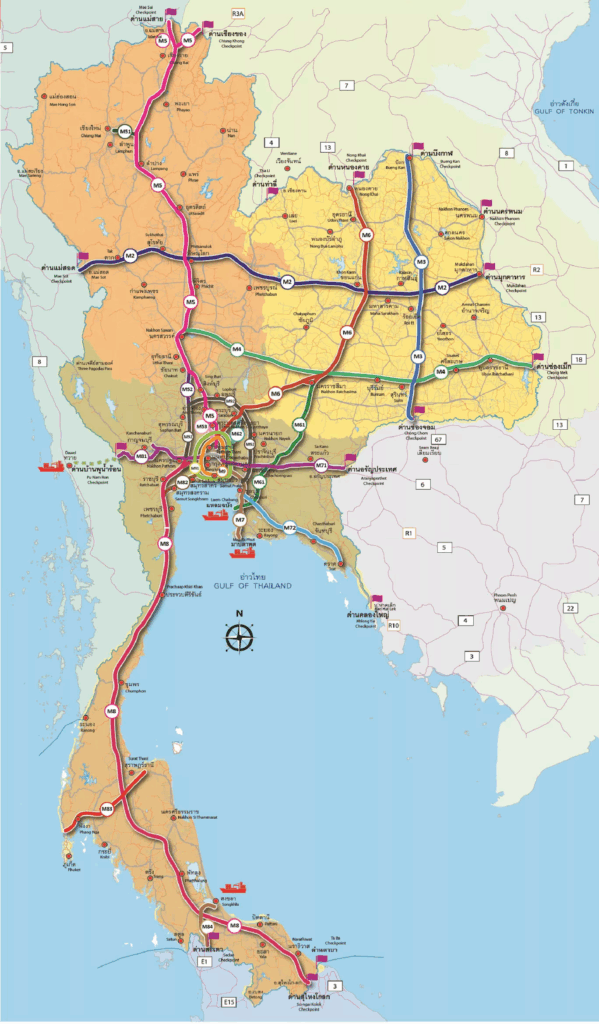
The northern end of the project, which once completed will be the first section of the M8 motorway (see the proposed Thailand motorway plan below), will connect to the M81 Bang Yai – Kanchanaburi motorway in Nakhon Chai Si district, Nakhon Pathom province, linking with Highway 4 (Phetkasem Road) and Highway 338 (Borommaratchachonnani Road).The first two phases will connect to Highway 35 (Rama II Road), currently the main north – south route from Bangkok, which itself has been undergoing major work for several years, with additional disruption caused by the new elevated M82 motorway; the work on Highway 35 itself is expected to be completed by the end of this year, while the motorway is scheduled for completion and opening in 2027, although some sections are going to be open soon, and others are likely to follow before that date.
Above: Thailand’s Intercity Motorway Development Master Plan, B.E. 2560 – 2579 (2017 – 2036). More information is available on the Department Of Highways website
In terms of how this will eventually impact both Cha-am and Hua Hin, other than the anticipated faster and smoother journey to Bangkok and back, it should hopefully reduce the traffic running through the centres of both, with the concept being that more traffic will use the Cha-am bypass road (Highway 37), and traffic that is destined for Hua Hin using one of several turn offs from the bypass to reach the part of Hua Hin they wish to reach, such as Highway 3218 (Pala-U Road), Highway 2043 (Soi 88), or Highway 2057 (Soi 112), rather than driving through both centres on the Phetkasem Road. While this makes sense in theory, whether it happens in practice is another matter entirely, but we all have to keep our fingers crossed that it does turn out that way, and that the weekend and holiday congestion in both locations is eased.